

- Function Features
- Reflective Memory Technology: Adopts reflective memory technology. Data written to the on – board global RAM will be automatically sent to the memory locations of all reflective memory boards on the network, realizing fast and efficient data sharing in distributed computer systems.
- Interrupt Function: Any node on the network can generate interrupts in other nodes or all nodes through a command. These interrupts (three – level, user – definable) can be used to synchronize system processes or track data, and the interrupts always follow the data to ensure that the data is received before the interrupt is acknowledged.
- Error Detection: The redundant transmission mode can suppress errors, with error – detection function.
- No Processor Overhead: The processor does not participate in the network operation, and the data transfer between nodes is software – transparent, without I/O overhead. Send and receive FIFOs buffer data during peak data rates to optimize CPU and bus performance.
- Node Numbering: Each node on the system has a unique identification number between 0 and 255, which is determined by placing jumpers on the circuit board during hardware system integration, and can be read by software accessing the on – board register.
- Application Scenarios
- Aerospace: It is used for satellite data processing and flight control systems. It can realize the high – speed transmission and sharing of a large amount of data between different subsystems, ensuring the normal operation of satellites.
- Military Electronics: Applied to the signal processing of radar and communication systems. It can meet the high – requirements of military applications for data transfer speed, reliability, and anti – interference, and ensure the accurate processing and transmission of radar echo signals and communication data.
- Scientific Research: Used in particle physics experiments and astronomical observation data analysis. In particle physics experiments, it can quickly share and process a large amount of data generated by detectors; in astronomical observation, it can help transmit and analyze observation data from various telescopes and other equipment.
- Industrial Automation: Used in robot control and production line data collection. In robot control, it can realize the real – time data sharing between the robot controller and each joint driver, enabling precise control of the robot’s movement; in production line data collection, it can collect and share the data of each sensor on the production line in time to facilitate real – time monitoring and control of the production process.
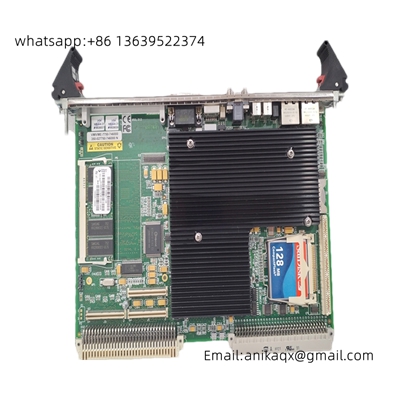
GE VMIVME-5576
echnical Specifications
wechatPhone +8613639522374
Phone: +8613639522374
Email: anikaqx@gmail.com
connect:Anika

Related Products


There are no reviews yet.