

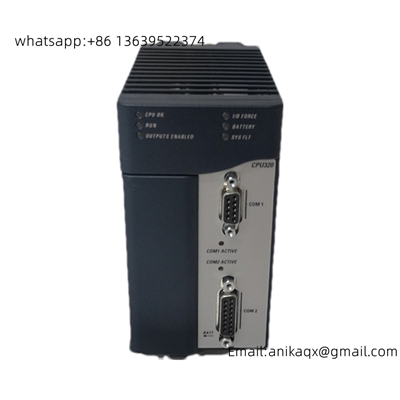

- Fieldbus Support: Genius, PROFINET, EGD, Profibus DP, and reflective memory communication via CMX modules.
- I/O Capacity: 32K discrete inputs/outputs (%I/%Q) and 32K analog inputs/outputs (%AI/%AQ).
- Expansion: Supports up to 8 local racks and 512 program blocks (each up to 128 KB).
- Environmental: Operates in temperatures from 0°C to 60°C and stores in -40°C to 85°C, with humidity tolerance from 5% to 95% (non-condensing).
Functional Characteristics
- High-Speed Processing: Boolean logic execution speed of 0.72 ms/k ensures rapid response in real-time control tasks.
- Multi-Protocol Communication: Enables seamless integration with diverse devices, including legacy systems and HMI panels.
- Large Program Capacity: 10 MB user memory accommodates complex applications, with optional energy packs for safe data storage during power failures.
- Flexible Programming: Supports ladder logic (LD), structured text (ST), function block diagrams (FBD), and C language, catering to different development preferences.
- Advanced Diagnostics: LED indicators (green/red/off/blinking) and built-in tools simplify troubleshooting and system monitoring.
- Hot-Swappable Design: Minimizes downtime during maintenance or upgrades.
- Compatibility: Works with 90-30 series modules, facilitating system migration or expansion.
Application Scenarios
- Automated Manufacturing: Controls robotic systems, assembly lines, and process parameters to ensure production efficiency and quality.
- Testing Equipment: Automates complex test sequences using precise analog I/O and high-speed logic.
- Oil and Gas Pipeline Monitoring: Connects to RTUs via Ethernet/serial interfaces for real-time pressure and flow monitoring.
- Refinery Automation: Integrates multiple devices to optimize production workflows and enhance safety.
- Substation Automation: Supports Modbus TCP/IP and Ethernet/IP for seamless SCADA integration and remote diagnostics.
- Power Distribution: Interfaces with smart meters and switches via PROFINET/Profibus DP for efficient grid management.
- Water Pump Control: Uses PID algorithms to regulate pump speed based on analog inputs (e.g., water level, flow rate), reducing energy consumption.
- Wastewater Treatment: Processes sensor data (e.g., pH, dissolved oxygen) to optimize treatment protocols.


There are no reviews yet.